




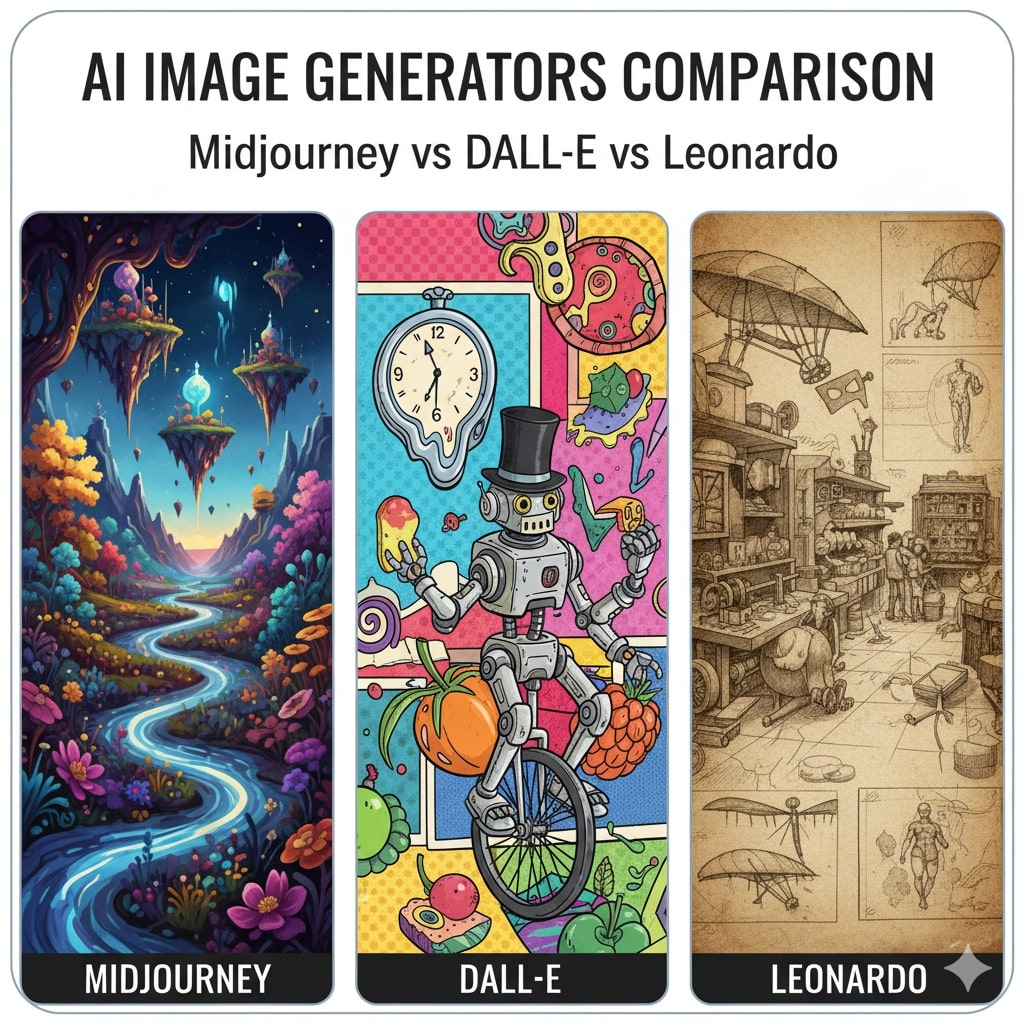
Artificial intelligence reshapes creative industries in profound ways. Image generation tools lead this transformation by turning simple text prompts into stunning visuals. Artists, designers, and marketers now rely on these platforms to accelerate workflows and explore ideas. Midjourney, DALL·E, and Leonardo stand out as top contenders in 2025. Each tool brings unique strengths to the table. Midjourney captivates with its artistic flair and community-driven evolution. DALL·E impresses through seamless integration with conversational AI and precise prompt interpretation. Leonardo excels in customization and professional-grade outputs for targeted applications.
Users face tough choices amid these options. Budget constraints play a key role in decisions. Beginners seek intuitive interfaces that minimize learning curves. Professionals demand advanced controls for consistency and scalability. This article dives deep into a head-to-head comparison. We examine core features, pricing structures, and real-world performance across diverse prompts. Data draws from expert reviews, user feedback, and hands-on tests conducted in late 2025. By the end, readers gain clarity on which generator aligns best with their needs. Creativity flourishes when tools match user intent perfectly. Let’s unpack these powerhouses one by one before pitting them against each other.
Midjourney: The Artistic Powerhouse
Midjourney thrives on Discord as its primary interface. This setup fosters a vibrant community where users share prompts and iterate collaboratively. Version 7, released in April 2025, elevates image quality to new heights with enhanced photorealism and stylistic coherence. Users input descriptive text, and the AI generates four variations per prompt. Parameters like –ar for aspect ratio or –v for version control allow fine-tuning. Remix mode enables seamless blending of existing images into new concepts. Video generation emerges as a fresh capability, competing with tools like Sora by animating static prompts into short clips.
Strengths define Midjourney’s appeal. It produces visually striking results that often surpass competitors in aesthetic depth. Complex scenes with multiple elements render cohesively, ideal for concept art or album covers. Community resources abound, offering prompt guides and style references. Commercial rights come standard on most plans, empowering freelancers to monetize outputs directly. Integration with tools like Photoshop via plugins streamlines post-production.
Challenges persist despite these advantages. The Discord dependency frustrates non-gamers or those preferring standalone apps. Images remain public by default on basic tiers, raising privacy concerns for sensitive projects. Stealth Mode, available only on higher plans, addresses this but adds cost. Learning the parameter syntax demands initial effort, though tutorials mitigate this hurdle. Overall, Midjourney suits creative explorers who value inspiration over speed.
Pricing follows a subscription model with four tiers. Basic starts at $10 monthly for 3.3 fast GPU hours, yielding about 200 images. Standard at $30 unlocks unlimited relaxed generations and 15 hours of fast time. Pro ($60) adds stealth and 30 hours, while Mega ($120) caters to heavy users with 60 hours and 12 concurrent jobs. Annual commitments yield 20% savings. No free tier exists since 2023, but shared subscriptions via platforms like GamsGo offer budget alternatives. Large enterprises must opt for Pro or Mega for full commercial licensing.
DALL·E: The Intuitive Conversational Creator
OpenAI’s DALL·E 3 integrates deeply with ChatGPT, making it a natural fit for text-heavy workflows. Users converse naturally to refine prompts, yielding precise outputs. Released in late 2023, it handles intricate descriptions with superior understanding, generating images up to 1792×1024 resolution. Features include inpainting for targeted edits and outpainting to expand canvases. Safety filters block harmful content while respecting artist copyrights through robust detection. Multilingual support broadens accessibility for global creators.
DALL·E shines in user-friendliness. Beginners craft detailed scenes without technical jargon, as the AI interprets colloquial language effortlessly. Integration with Microsoft Copilot extends reach to enterprise tools. Outputs excel in clean compositions and multi-subject harmony, perfect for illustrations or ad mockups. Ethical safeguards build trust, ensuring compliant generations. API access enables developers to embed it into custom apps.
Drawbacks temper its strengths. Strict content policies limit edgy or abstract explorations, frustrating artists seeking unrestricted creativity. Outputs sometimes appear overly polished, bordering on cartoonish compared to photorealistic rivals. Generation speed lags during peak hours on free tiers. Customization pales against specialized tools, lacking advanced model training.
Access ties to ChatGPT subscriptions. Free users get limited DALL·E 2 credits, but full DALL·E 3 requires Plus at $20 monthly, including unlimited generations within message caps. Team ($25/user) and Enterprise plans scale for businesses. API pricing charges per image: $0.040 for standard, $0.080 for HD. This bundled model suits multitaskers leveraging ChatGPT’s full suite.
Leonardo: The Versatile Professional Suite
Leonardo AI targets pros with its web-based platform, bypassing Discord or chat interfaces. Launched for gaming assets, it now spans illustrations, 3D textures, and videos. The Phoenix model powers high-fidelity renders, while Motion 2.0, updated in 2025, smooths video generation with better frame rates. Users train custom models on datasets for brand-consistent outputs. Negative prompts exclude unwanted elements, and ControlNet guides poses or compositions. Realtime Canvas allows on-the-fly edits, blending AI with manual tweaks.
Leonardo’s toolkit impresses with depth. Photorealism rivals Midjourney, yet it adds 3D capabilities for textures and assets. Batch processing handles high volumes efficiently, suiting marketers or studios. Community presets and a prompt enhancer accelerate ideation. Ownership rights grant full commercial freedom across plans. API integration empowers scalable deployments.
Limitations surface in niche areas. Character consistency falters without precise seeds, and relaxed mode slows during queues. The token system confuses newcomers, as costs vary by action. Free tier watermarks hinder professional previews.
Pricing revolves around tokens, with five tiers. Free offers 150 daily tokens for 20-30 images. Apprentice ($9/month) provides 8,500 tokens, removing watermarks. Artisan ($29) bumps to 25,000, adding custom training. Maestro ($60) delivers 60,000 with priority speed. Ultra ($99) unlocks unlimited fast generations. Annual discounts reach 20%, and relaxed mode extends use post-depletion. This structure favors volume users.
Head-to-Head Comparison: Features, Performance, and Use Cases
Core features diverge sharply across these tools. Midjourney emphasizes stylistic variety through parameters like –stylize, producing moody, artistic renders. DALL·E prioritizes prompt fidelity, excelling in literal interpretations with conversational refinement. Leonardo bridges both with modular controls, including alchemy for upscaling and elements for style transfer. All support text-to-image, but Leonardo adds video and 3D, Midjourney offers remix for iterations, and DALL·E includes editing via ChatGPT.
Use cases highlight ideal fits. Artists flock to Midjourney for inspirational brainstorming in galleries or book covers. Marketers prefer DALL·E for quick, compliant ad visuals integrated with copywriting. Game developers choose Leonardo for asset pipelines, training models on character sheets for consistency. Budget-conscious hobbyists start with Leonardo’s free tier, while enterprises scale via DALL·E’s API.
Pricing stacks up differently. Midjourney’s $10 entry yields fixed GPU time, best for moderate use. DALL·E’s $20 bundle maximizes value for ChatGPT users. Leonardo’s token flexibility suits variable workloads, though overages add up. Annual savings make long-term commitments worthwhile across all.
| Aspect | Midjourney | DALL·E | Leonardo |
|---|---|---|---|
| Interface | Discord-based | ChatGPT-integrated | Web app |
| Key Strength | Artistic styles | Prompt understanding | Custom training |
| Resolution | Up to 2048×2048 | Up to 1792×1024 | Up to 1536×1536 |
| Free Tier | None | Limited (DALL·E 2) | 150 tokens/day |
| Starting Price | $10/month | $20/month (Plus) | $9/month |
| Best For | Creatives | Beginners/Marketers | Professionals |
This table underscores trade-offs. Midjourney wins on inspiration, DALL·E on accessibility, Leonardo on versatility.
Conclusion
Midjourney, DALL·E, and Leonardo each carve distinct niches in AI image generation. Choices hinge on priorities: artistry, ease, or customization. Experimentation unlocks potential. Future updates promise even greater convergence, blending strengths into hybrid workflows. Creators thrive by selecting tools that amplify their vision. Dive in, prompt boldly, and watch ideas materialize.