





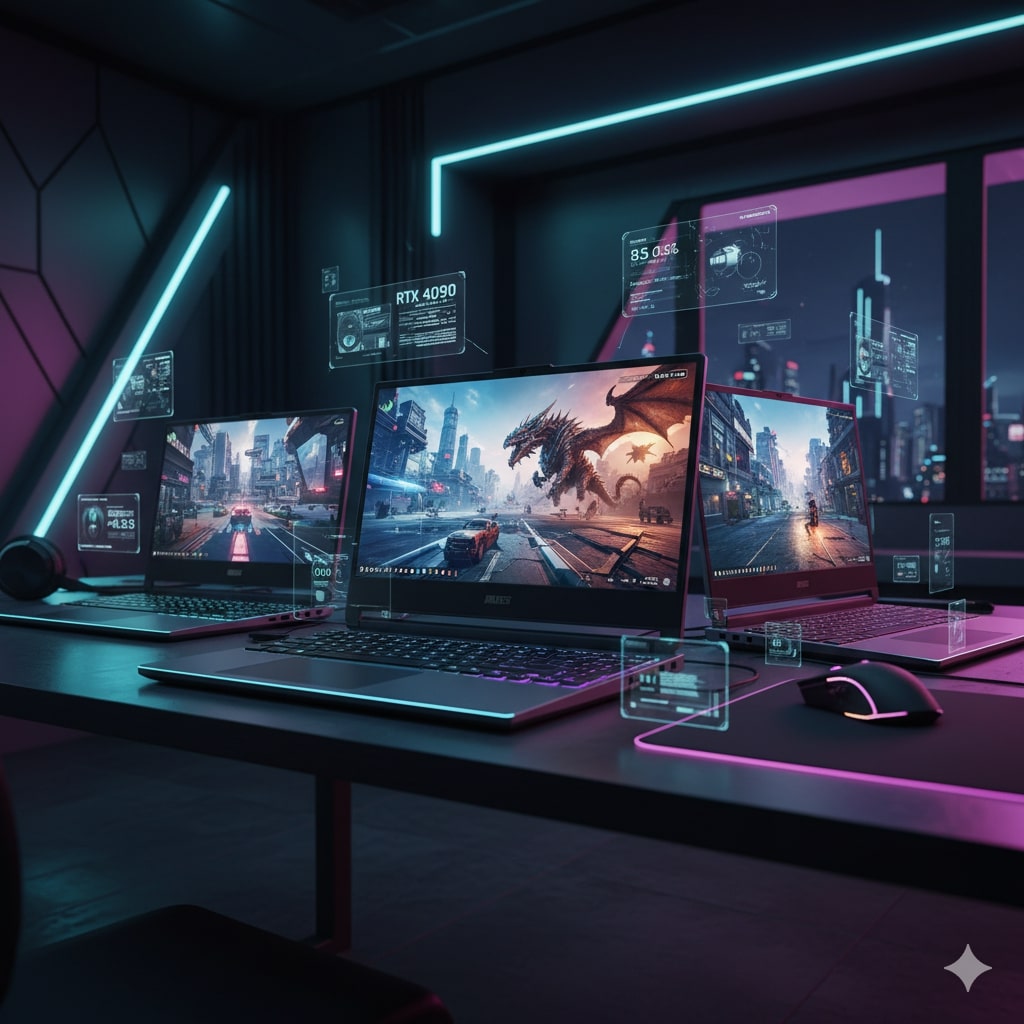
Gaming laptops have transformed from clunky, underpowered machines into sleek, high-performance devices capable of rivaling desktop rigs. The NVIDIA GeForce RTX 40 Series stands at the forefront of this evolution. Built on the Ada Lovelace architecture, these GPUs deliver unprecedented power efficiency, ray tracing realism and AI-driven upscaling through DLSS 3. As of October 2025, RTX 40 Series laptops dominate the market, offering gamers portable access to cutting-edge graphics. This article explores how these laptops shape the future of gaming, from core technologies to top models, performance benchmarks and the looming transition to the RTX 50 Series.
The RTX 40 Series: Power in a Portable Package
NVIDIA launched the mobile RTX 40 Series at CES 2023. The lineup spans from the budget-friendly RTX 4050 to the flagship RTX 4090, the first 90-class GPU in a laptop form factor. The RTX 4090 packs 16 GB of GDDR6 memory and 9,728 CUDA cores. It achieves up to 4x the ray tracing performance of the RTX 30 Series. Third-generation RT Cores handle complex light simulations. Fourth-generation Tensor Cores power AI features like DLSS 3.
Efficiency defines the series. The RTX 4070 matches the RTX 3080’s performance while using one-third the power. Max-Q technologies optimize battery life and thermals. Laptops run demanding games for up to two hours unplugged. Thin designs under 15 mm become possible without sacrificing speed. Over 170 laptop models from ASUS, MSI, Razer and Lenovo incorporate RTX 40 GPUs. Prices start at $999 for RTX 4050 configurations. High-end RTX 4090 models reach $3,000 or more.
DLSS 3 uses AI to generate entire frames. Frame rates double in supported titles. Cyberpunk 2077 at 1440p ultra with ray tracing hits 100 FPS on an RTX 4070. Without DLSS, it struggles at 40 FPS. NVIDIA Reflex reduces system latency by up to 75%. Competitive gamers gain split-second advantages in titles like Valorant and Counter-Strike 2.
Core Technologies Driving Innovation
Ada Lovelace architecture introduces several breakthroughs. Shader Execution Reordering boosts ray tracing efficiency by 25%. DLSS 3 combines super-resolution with frame generation. Optical Flow Accelerator analyzes motion between frames. AI predicts and inserts new frames with minimal artifacts. Over 500 games will support DLSS 3 by late 2025.
Ray tracing simulates light behavior realistically. Shadows reflect accurately. Reflections appear in puddles and glass. Global illumination lights scenes naturally. RTX 40 laptops render these effects at playable frame rates. Portal RTX runs at 60 FPS on RTX 4080 models. Older GPUs manage 15 FPS at best.
NVIDIA Broadcast enhances streaming. AI removes background noise. Virtual green screens work without physical backdrops. Eye contact correction maintains viewer engagement. Content creators stream 4K gameplay smoothly. AV1 encoding cuts bandwidth by 50% compared to H.264. Viewers experience higher quality at lower bitrates.
Battery life improves dramatically. Fifth-generation Max-Q enables dynamic power allocation. GPUs throttle intelligently during light tasks. The ASUS ROG Zephyrus G14 with RTX 4070 lasts 10 hours for productivity. It delivers 90 minutes of gaming at 1440p. Vapor chamber cooling keeps temperatures below 85°C under load.
Top RTX 40 Series Laptops in 2025
Several models stand out. The Lenovo Legion Pro 7i Gen 9 pairs an Intel Core i9-14900HX with an RTX 4080. It pushes 140W TGP. The 16-inch 240 Hz QHD display supports G-Sync. Per-key RGB lighting enhances aesthetics. Prices drop to $1,800 during 2025 sales. It handles 4K external gaming via Thunderbolt 4.
The ASUS ROG Zephyrus G14 targets portability. An AMD Ryzen 9 8945HS combines with an RTX 4070. The 14-inch 3K OLED panel offers 120 Hz refresh and 100% DCI-P3 coverage. Weight stays under 3.5 pounds. Battery life reaches 11 hours for web browsing. It costs around $1,500 on discount. AniMe Matrix LED lids allow custom animations.
Budget gamers choose the Acer Nitro V 15. An Intel Core i7-13620H and RTX 4050 deliver 1080p ultra gaming at 70 FPS. The 15.6-inch 165 Hz IPS screen suffices for esports. Upgradable RAM and SSDs extend longevity. It sells for $900. Dual-fan cooling manages heat adequately.
The MSI Raider GE78 represents the high end. An RTX 4090 and Core i9-14900HX achieve 175W TGP. The 17.3-inch 360 Hz QHD panel minimizes motion blur. Mystic Light RGB syncs across peripherals. It excels in 4K ray-traced gaming at 120 FPS with DLSS. Prices hover near $2,800. Phase-change thermal pads reduce throttling.
Performance Benchmarks and Real-World Use
Benchmarks showcase dominance. In 3DMark Time Spy, the RTX 4090 laptop scores 18,000 points. The RTX 3080 Ti manages 12,000. Cyberpunk 2077 at 1440p with RT Overdrive hits 120 FPS on RTX 4090 with DLSS 3. The same settings yield 35 FPS on RTX 3090. Control with full ray tracing runs at 90 FPS on RTX 4070. Older GPUs drop to 25 FPS.
Esports performance excels. Fortnite at 1440p competitive settings reaches 300 FPS on RTX 4060. Reflex cuts latency to 12 ms. Call of Duty: Warzone at 1440p ultra averages 180 FPS on RTX 4080. Streaming overlays add negligible overhead. Blender rendering accelerates 4x faster. A complex scene exports in 2 minutes versus 8 on the RTX 30 Series.
Battery gaming improves. The Zephyrus G16 with RTX 4080 plays Cyberpunk at 60 FPS for 90 minutes. Light tasks extend to 12 hours. External 4K monitors run at 120 Hz via HDMI 2.1. Multi-monitor setups support productivity. Thermals remain stable. Fans peak at 45 dB under load.
Compared to consoles, RTX 40 laptops outperform. The PS5 Pro achieves 60 FPS in ray-traced games at dynamic 4K. An RTX 4070 laptop doubles that at native 1440p. Modding communities thrive. Skyrim with 8K textures and ENB runs smoothly. Indie developers use Unreal Engine 5 efficiently.
Creative and Professional Applications
RTX 40 laptops serve beyond gaming. Adobe Premiere Pro leverages GPU acceleration. 8K video timelines play in real time. DaVinci Resolve color grades for 4K footage instantly. PugetBench scores for Photoshop rise 40% over RTX 30 Series. 3D artists model in Blender with viewport ray tracing. Cycles X renders finalize in minutes.
NVIDIA Studio drivers optimize creative workflows. Omniverse connects teams in real time. Architects visualize buildings collaboratively. AI tools like Stable Diffusion generate art locally. The RTX 4090 processes 100 images per minute. VR development in Unity runs at 90 FPS. Oculus Link delivers PC VR quality wirelessly.
Students benefit from portability. Engineering simulations in MATLAB accelerate via CUDA. Data scientists train models faster. The RTX 4060 handles PyTorch datasets efficiently. Battery life supports all-day lectures. Lightweight designs fit backpacks easily.
The Road to RTX 50 Series
NVIDIA prepares the RTX 50 Series for 2026. Blackwell architecture promises 2x efficiency gains. DLSS 4 introduces multi-frame generation. Rumors suggest 24GB GDDR7 on RTX 5090 mobile. Power draws may reach 200W. Chassis designs evolve with better cooling.
Early 2026 launches target CES. Pricing starts at $1,200 for RTX 5050. High-end models exceed $4,000. The RTX 40 Series receives discounts. Stock clears by mid-2026. Super variants never materialized for the 40 Series. Value increases for current owners.
AI integration deepens. Neural rendering enhances textures. Path tracing becomes standard. Cloud gaming hybrids emerge. Local hardware handles primary rendering. Streaming fills gaps during travel. Sustainability improves. Recycled aluminum reduces carbon footprint.
Challenges Facing RTX 40 Laptops
High power consumption limits battery gaming. RTX 4090 models drain in 60 minutes at max settings. Thermal constraints cap performance. Budget chassis throttle at 80W TGP. Soldered components prevent upgrades. RAM maxes at 32GB in many models.
Supply chain issues linger. GPU shortages peaked in 2024. Prices remain elevated. Software optimization varies. Some games lack DLSS support. Driver bugs occasionally cause crashes. NVIDIA resolves most within weeks.
Ergonomics matter. 17-inch models weigh over 6 pounds. Heat exhausts near keyboards. The WASD keys get warm during long sessions. Display flickering affects mini-LED panels. Firmware updates mitigate issues. Warranty coverage varies by brand.
Choosing the Right RTX 40 Laptop
Buyers prioritize needs. Casual gamers select RTX 4060 models under $1,200. Competitive players need 240 Hz screens and low latency. Content creators demand color-accurate displays. Professionals value battery life and portability. Thermal headroom ensures longevity.
Reputable brands offer better support. ASUS ROG provides three-year warranties. Razer Premium Care covers accidents. Lenovo Legion includes ADP. Read reviews for build quality. Check return policies. Sales during Black Friday cut costs 30%.
Future-proofing involves balance. The RTX 4070 handles 1440p for years. 16GB VRAM suffices for most titles. Fast SSDs reduce load times. Wi-Fi 7 prepares for faster networks. Thunderbolt 5 enables eGPUs later.
The Broader Impact on Gaming Culture
RTX 40 laptops democratize high-end gaming. College students play AAA titles in dorms. Travelers enjoy graphics on flights. Cafes host LAN parties with portable rigs. Streaming from anywhere becomes viable. Mobile esports grows.
Indie developers access powerful tools. Unreal Engine 5 projects compile quickly. Asset creation accelerates. Small teams compete with studios. Modding communities expand. Realism enhances immersion.
Cloud saves sync progress. GeForce Now streams unplayable titles. Local hardware runs most games natively. Hybrid approaches dominate. Physical media fades. Digital distribution reigns.
Conclusion
RTX 40 Series laptops redefine mobile gaming. They deliver desktop-class performance in portable form. DLSS 3 and ray tracing create stunning visuals. Efficiency enables thin, light designs. Top models cater to every budget and need. Benchmarks prove real-world dominance. The transition to RTX 50 approaches. Current owners enjoy mature, optimized hardware. Discounts make entry accessible. The future of gaming arrives today in a laptop bag. Whether battling dragons or rendering films, RTX 40 empowers creators and players alike. Gaming evolves. Portability wins.