





You’ve got two tabs open. One showing an Amazon Echo, one showing a Google Nest. You’ve been going back and forth for twenty minutes. Sound familiar?
Here’s the thing: this isn’t really a speaker decision. It’s an ecosystem decision. And once you pick one, switching costs money, time, and a lot of frustration. So let’s settle this properly.
This is a real comparison of Amazon Echo vs Google Home in 2026, updated for the current product lineup, the latest Matter smart home standard rollout, and what’s actually changed since both platforms got major updates in late 2025.
What Is the Difference Between Amazon Echo and Google Home?
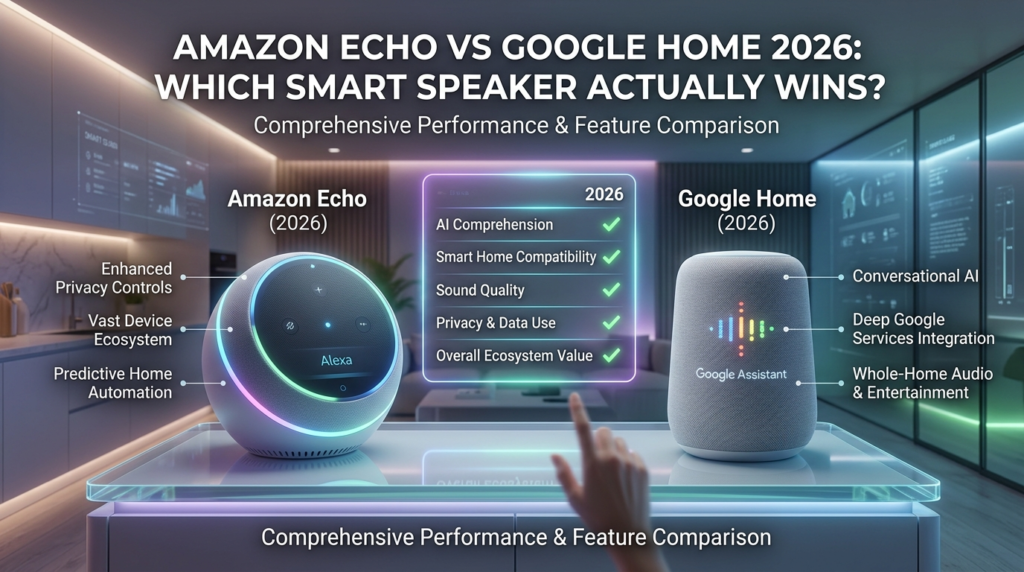
Amazon Echo runs on Alexa and specializes in smart home device control and Amazon shopping integration, while Google Home (now called Google Nest) runs on Google Assistant and leads in conversational intelligence and Google ecosystem connectivity.
That one-line answer is accurate. But it’s not enough to make a real decision. Let’s go deeper.
Which Is Smarter: Alexa or Google Assistant in 2026?
Google Assistant is still the smarter conversational AI in 2026, handling follow-up questions, multi-step commands, and general knowledge queries with noticeably more accuracy than Alexa.
This gap actually widened slightly in early 2026. Google pushed a major Assistant update tied to its Gemini AI integration, making natural conversation feel genuinely fluid. Ask the Google Assistant about a topic, then follow up with “what about before that?” and it knows what you mean without needing a full repeat of the prompt.
Alexa has improved. The Alexa Plus upgrade (available on newer Echo devices) added LLM-backed responses that are much better than the old keyword-matching days. But Google still has a clear edge in nuanced questions, real-time information, and context retention throughout the conversation.
Where Alexa genuinely pulls ahead:
- It offers multiple wake words: “Alexa,” “Echo,” “Amazon,” and “Computer.” That’s useful if a single word gets triggered too often by accident.
- For Amazon Prime members, order tracking and reordering via voice is seamless in a way Google simply can’t match.
- The Skills library still has over 100,000 third-party integrations. Niche use cases, such as specific appliance controls, games, and business tools, are more likely to have Alexa support.
“If you’re asking your smart speaker trivia questions and setting reminders, Google Assistant wins on raw intelligence every single time. If you’re controlling fifteen smart home devices and ordering household supplies, Alexa’s depth of integration is unmatched.” (Smart Home Technology Analyst Perspective, 2026)
Which Smart Speaker Has Better Smart Home Compatibility?
Amazon Echo still leads in raw smart home device compatibility in 2026, working with tens of thousands of brands and devices. But the gap is closing fast thanks to the Matter standard that both platforms now support.
This used to be a straightforward Alexa win. It’s getting more complicated.
Matter is the cross-platform smart home standard backed by Apple, Google, Amazon, and Samsung. It reached widespread adoption through 2025 and into 2026. What that means practically: a Matter-certified smart bulb or plug now works natively with both Alexa and Google Assistant without needing a brand-specific bridge or hub. That’s a big deal.
That said, here’s where each platform still has real advantages:
Amazon Echo advantages for the smart home:
- Many Echo devices have a built-in Zigbee hub. This lets you connect older Zigbee-protocol devices without a separate bridge.
- Deep integration with Ring doorbells, Blink cameras, and Amazon’s own security ecosystem.
- Routines are highly customizable and can trigger based on time, sensor events, or voice.
- If you’re building a home security setup, Ring plus Echo is one of the most integrated options available.
Google Nest advantages for smart home:
- Native connection to Nest Thermostat, Nest Doorbell, and Nest Cam. Google’s own hardware ecosystem is tighter than most realize.
- The Google Home app received a full redesign in 2025 and is now genuinely more intuitive for managing multiple rooms and devices.
- Chromecast integration means casting video from your phone to your TV is a one-command action.
- If your home already runs on Google services like Calendar, Maps, and Gmail, the contextual awareness Google Assistant brings to your smart home routines is noticeably better.
Based on observations from early 2026, homes set up with new Matter-compatible devices are finding the compatibility gap nearly irrelevant for standard setups. Where Echo still wins is legacy device support and the security ecosystem around Ring.
Amazon Echo vs Google Nest: Which Has Better Sound Quality?
For premium sound, both the Amazon Echo Studio and the Google Nest Audio deliver genuinely impressive audio. The Echo Studio edges out Nest Audio for music clarity at high volumes, while Nest Audio offers a warmer, more natural tone at moderate listening levels.
Let’s be real about the entry-level devices first. The Echo Dot (5th gen) and Nest Mini both sound like small speakers because they are. They’re fine for voice responses, timers, and background music at low volume. Don’t buy either of these expecting hi-fi audio.
For actual music listening, here’s how the current lineup stacks up:
- Echo Studio: 330W total output across five drivers, Dolby Atmos support, and spatial audio processing. It’s the best-sounding smart speaker Amazon has made, full stop. Price point sits around 200 dollars.
- Nest Audio: 75W output with a 75mm woofer and 19mm tweeter. It’s not as powerful as Echo Studio, but its sound profile is balanced and pleasing for casual listening. Around 100 dollars.
- Echo Show 10: Good sound for a display device, with a 3-inch woofer and two tweeters. If you want a smart display that also handles music reasonably well, this is solid.
- Nest Hub Max: Better audio than you’d expect from a display, but you’re buying it for the screen features, not the sound.
For pairing with a sound system you already own, the Echo Dot has a 3.5mm aux output. The Nest Mini does not. That one detail matters if you’re connecting to older speakers.
Which Smart Display Is Worth Buying: Echo Show or Nest Hub?
The Echo Show is the better choice if you want video calling, Amazon shopping, and Ring camera feeds. The Nest Hub is better if you want Google Photos, YouTube casting, and a built-in sleep tracking sensor.
Smart displays are where this comparison gets interesting, because both companies have leaned hard into screens as the center of the smart home experience.
The Echo Show line now spans from the compact Echo Show 5 to the full-size Echo Show 15, which mounts on a wall and works as a family command center showing calendars, sticky notes, and home security feeds. If you’re a Ring security camera user, the Echo Show is genuinely useful as a live monitoring hub.
The Nest Hub Max has one feature that no Echo device has: a built-in camera with face recognition. It identifies who’s standing in front of it and personalizes the display by showing your calendar, your reminders, and your commute info. In a household with multiple people, that’s actually a meaningfully different experience.
The standard Nest Hub (without the camera) also has a passive sleep-tracking sensor that uses radar technology. It detects breathing and movement to give you a basic sleep report, with no app required and no wearable needed. For anyone tracking sleep health without wanting another device to charge, that’s a real differentiator.
Is Amazon Echo or Google Home Better for Privacy?
Both Amazon and Google let you mute microphones, review recordings, and auto-delete your voice history. Google has been slightly more transparent about its data practices in recent years, while Amazon has added more granular privacy controls to newer Echo devices.
This is a real concern and worth taking seriously. Both devices are always listening for their wake word. That means a microphone in your home is always active at some level.
What you can actually do on both platforms:
- Physical microphone mute buttons are available on both, and they physically disconnect the mic circuit.
- Auto-delete voice recordings on a schedule (3 months, 18 months, or never stored).
- Review and manually delete recordings from the companion app.
- Opt out of having recordings used to improve AI models.
The honest take: if privacy is your top concern, neither of these devices is a natural fit. But if you’ve decided the convenience trade-off is worth it, both platforms in 2026 give you enough control to manage your exposure reasonably well. Check your settings when you first set up, and don’t leave them at the defaults.
Can You Use Amazon Echo and Google Home Together in the Same House?
Yes, you can run both Amazon Echo and Google Nest devices in the same home. They operate completely independently through their own separate apps.
Some people do this intentionally. A Google Nest Hub Max in the kitchen for visual recipes and YouTube, Echo devices in the bedrooms for Alexa routines and Amazon shopping. It’s not a problem technically. The only friction is managing two apps and two assistant relationships.
With Matter now mature, most of your smart home devices can be controlled by either platform simultaneously. So you’re not locked into one controller for your lights or thermostat just because you bought a speaker from one brand.
Amazon Echo vs Google Home: Which Should You Actually Buy?
Buy an Amazon Echo if you’re an Amazon Prime member, have or plan to get Ring or Blink security devices, or want the widest smart home device compatibility. Buy Google Nest if you live in the Google ecosystem, want a more conversational AI assistant, or use Chromecast and YouTube regularly.
Here’s the clean breakdown:
Go with Amazon Echo if:
- You shop on Amazon regularly and want voice ordering and Prime delivery tracking.
- You’re building or already have a Ring or Blink home security setup.
- You want maximum device compatibility, especially for older or niche smart home brands.
- You want the best standalone smart speaker audio under 250 dollars (Echo Studio).
- You need Zigbee hub functionality built in without buying a separate bridge.
Go with Google Nest if:
- You use Android, Gmail, Google Calendar, or Google Maps daily. The integration is genuinely seamless.
- You want the smartest, most conversational voice assistant for general questions and follow-up queries.
- You cast video to your TV regularly and want Chromecast to work with a single voice command.
- You want the Nest Hub Max’s face recognition or the standard Nest Hub’s radar sleep tracking.
- You’re already invested in Nest Thermostat, Nest Doorbell, or Nest Cam.
“In 2026, the smart home platform you pick is really a bet on which company’s broader services you trust more. The speakers themselves are almost equal. The ecosystems behind them are not.” (Consumer Tech Strategy Perspective, 2026)
One practical test before you commit: open your phone and count how many Google apps vs Amazon apps you use in a typical week. That ratio is probably the most honest predictor of which ecosystem will actually feel natural in your home. Don’t overthink the specs. Buy the one that fits how you already live.