





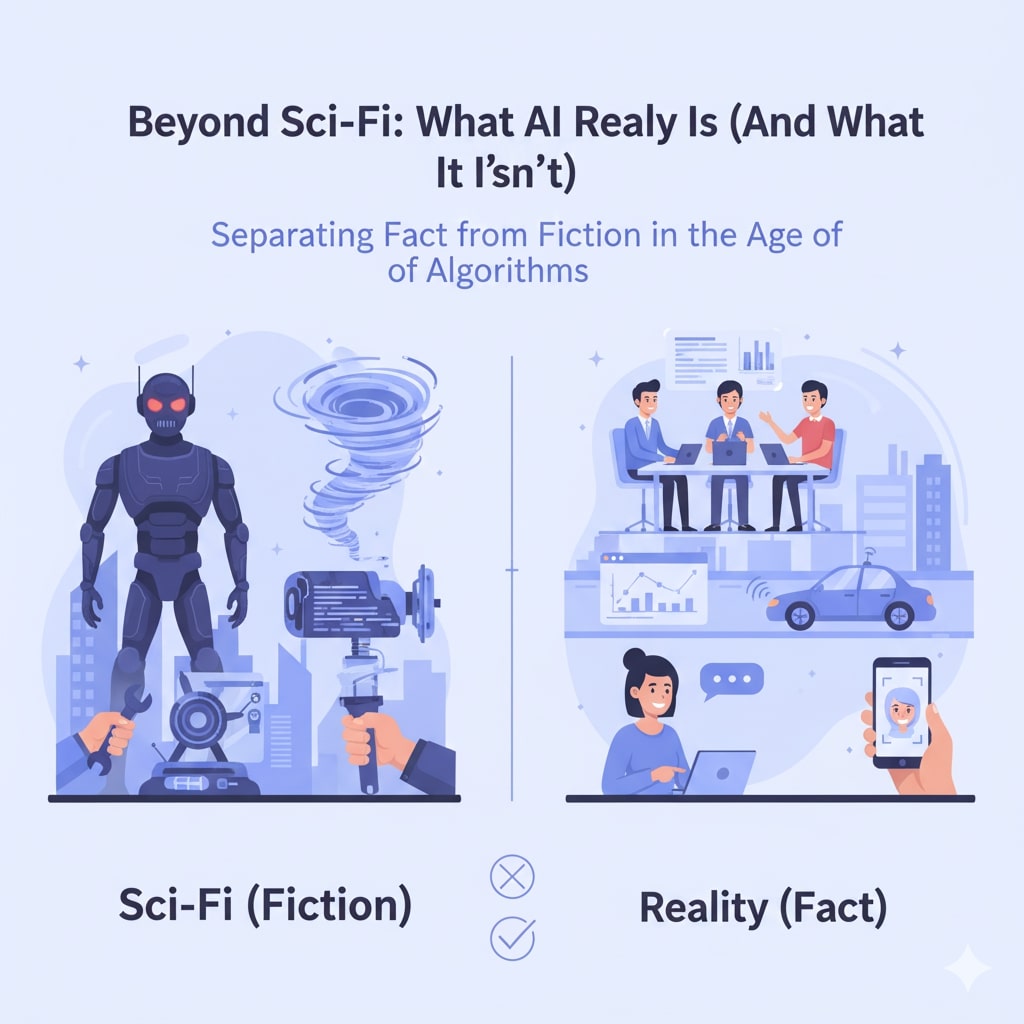
Artificial intelligence dominates headlines, fuels blockbuster movies and sparks endless debate. Robots overthrow humanity in The Terminator. Superintelligent systems solve world hunger in utopian visions. Reality sits somewhere in between. AI exists today. It powers your phone, recommends your music and detects fraud on your credit card. This article strips away Hollywood myths. It explains what AI actually does, how it works, its limit and where it falls short of science fiction. No jargon. No exaggeration. Just clarity.
Core Truth: AI Is Pattern Recognition
boils down to one idea. Machines find patterns in data. Give a system thousands of cat photos. It learns to identify cats. Show it millions of purchase records. It predicts your next buy. No magic. No consciousness. Just math.
Computers process inputs. They produce outputs. Inputs include images, text, numbers, or sensor readings. Outputs range from labels (“cat”) to actions (brake the car) to generated content (write an email). The system adjusts internal numbers—called weights—to minimize errors. This process repeats millions of times during training.
Humans write the code. They collect the data. They define the goal. AI does not invent objectives. It optimizes what you tell it to optimize. A chess AI wins games. It does not care about winning. It follows the reward function.
Where AI Came From
began in the 1950s. Scientists wanted machines to mimic human reasoning. Early programs played checkers. They solved logic puzzles. Progress stalled. Computers lacked power. Data was scarce. Interest faded during “AI winters.”
The internet changed everything. Billions of photos, texts and videos became available. Chips grew faster. Graphics cards (GPUs) handled parallel math. In 2012, a neural network crushed an image recognition contest. Accuracy leaped from 70% to 85% in one year. The deep learning revolution started.
Today, AI runs on cloud servers. It trains on data centers with thousands of GPUs. Cost drops. Tools spread. Anyone with a laptop experiments.
Types of AI:
Hollywood loves general intelligence. One system rules all tasks. Real AI stays narrow. Siri answers questions. It cannot drive a car. AlphaFold predicts protein shapes. It cannot write poetry.
Narrow AI excels in defined domains. It beats humans at specific games—chess, Go, StarCraft. It diagnoses skin cancer from photos better than dermatologists in controlled tests. It fails outside its training.
General AI (AGI) remains a dream. No machine reasons like a human across subjects. No system learns a new skill from one example. Children grasp “dog” after seeing three pictures. AI needs thousands.
Superintelligence—AI smarter than all humans combined—lives in thought experiments. No evidence suggests it nears. Current models memorize and remix. They do not innovate.
How AI Actually Works:
Neural networks dominate AI. They stack layers of nodes. Each node multiplies inputs by weights. It adds a bias. It applies a simple function. Early layers detect edges. Middle layers find shapes. Final layers recognize objects.
Training adjusts billions of weights. Errors flow backward. The system nudges numbers to reduce mistakes. This repeats until performance plateaus.
Transformers power language models. They process entire sentences at once. Attention mechanisms weigh word importance. GPT models generate text by predicting the next token. They do not understand meaning. They calculate probabilities.
Vision models use convolutions. They slide filters over pixels. They detect patterns like corners or textures. Output feeds classifiers.
Reinforcement learning trains agents through trial and error. Rewards shape behavior. AlphaGo learned by playing itself millions of times.
Real AI in Action:
filters your email. It scans message content, sender history and links. It flags 99.9% of spam. You notice the 0.1% that slips through.
Netflix suggests shows. It tracks what you watch, skip and rate. It clusters users with similar tastes. It recommends titles you likely enjoy.
Tesla cars avoid crashes. Cameras capture roads. Radar measures distance. AI decides when to steer or brake. It logs billions of miles. It updates over the air.
Doctors use AI for diagnostics. Algorithms analyze retinal scans. They detect diabetic retinopathy early. They reduce blindness in underserved areas.
Factories deploy robots. Vision systems guide arms. They assemble parts with micron precision. They work 24/7 without fatigue.
What AI Cannot Do (Yet)
lacks common sense. Ask it why chickens cross roads. It generates jokes. It does not grasp causality. It parrots patterns from training data.
invents facts. Language models hallucinate. They sound confident. They state nonsense. Always verify outputs.
shows no creativity. It remixes existing ideas. It does not experience inspiration. New art, music, or science requires human direction. feels nothing. It simulates empathy in chatbots. It follows scripts. It detects sadness in voice tone. It offers pre-written comfort.
learns slowly outside its domain. Teach it chess. It masters chess. It still fails at checkers without retraining.
Energy Problem Nobody Talks About
Training large models consumes power. One run of GPT-3 used energy equal to 120 U.S. homes for a year. Inference—running the model—adds up. Millions of daily queries burn electricity.
Data centers cool servers. They emit carbon. Efficiency improves. New chips cut power 30% per generation. Renewable energy powers some facilities. The footprint grows with demand.
Edge AI moves computation to devices. Phones run models locally. Latency drops. Privacy rises. Battery life limits scope.
Bias: AI’s Mirror, Not Its Mind
reflects training data. Biased data produces biased outputs. Facial recognition misidentifies dark skin more often. Early datasets favored light skin. Hiring tools rejected women. Resumes lacked male-coded words.
Fixes involve diverse data. Fairness metrics flag disparities. Human oversight catches errors. Perfect neutrality stays impossible. Society contains bias. AI absorbs it.
Jobs: Evolution, Not Extinction
automates routine tasks. Cashiers scan items. Drivers follow routes. Writers draft boilerplate. Jobs shift.
New roles emerge. Prompt engineers craft inputs. Data labelers clean datasets. Ethicists audit models. Trainers fine-tune systems.
Creativity, judgment and empathy resist automation. Teachers adapt to students. Nurses comfort patients. Leaders inspire teams.
Ethics Beyond the Hype
Privacy erodes. Cameras track faces in public. Apps log behavior. Data fuels AI. Consent blurs.
Accountability gaps widen. Self-driving cars crash. Who pays? Developers? Owners? Insurers?
Weaponization looms. Drones target autonomously. Deepfakes spread lies. Regulations lag.
Transparency matters. Black-box models hide reasoning. Explainable AI opens the box. Users demand insight.
The Future: Collaboration
augments humans. Designers iterate faster. Doctors diagnose accurately. Farmers optimize yields. Students learn at their pace.
Multimodal models combine text, image and sound. Robots navigate homes. Assistants schedule lives.
Regulation shapes growth. Laws mandate safety. Audits ensure fairness. Global standards prevent races to the bottom.
Education spreads literacy. Everyone understands AI basics. Critical thinking counters misinformation.
Getting Started:
Free tools abound. Google Colab offers GPUs. Hugging Face hosts models. Kaggle runs competitions.
Learn Python. Study NumPy, Pandas and PyTorch. Build a spam classifier. Train an image generator. Share on GitHub.
Read papers on arXiv. Follow AI news. Join Discord communities. Ask questions.
Leading the Charge
Google, OpenAI, Meta and Microsoft push boundaries. Startups innovate in niches. China’s Baidu and Alibaba scale nationally. Universities publish open research.
Safety-focused labs like Anthropic prioritize alignment. Open-source communities share code. Collaboration accelerates progress.
Conclusion
lives beyond sci-fi. It solves real problems today. It fails at others. It amplifies human intent—good and bad. Understand its mechanics. Question its outputs. Guide its development. The future depends not on machines alone, but on the choices we make. AI serves as a tool. Wield it wisely.