





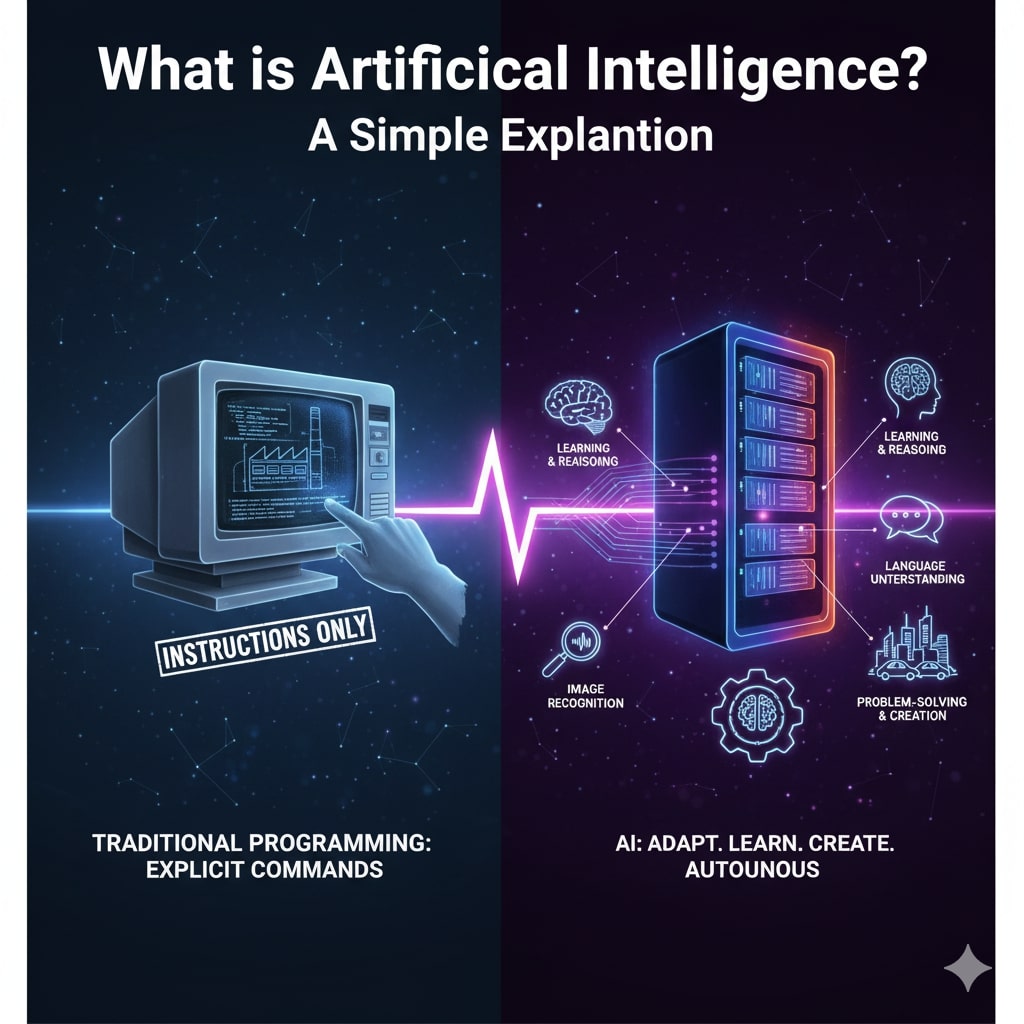
Artificial Intelligence (AI) powers many tools people use daily. Smartphones suggest words while typing. Streaming services recommend shows. Cars park themselves. All these features rely on AI. Yet most users never think about the technology behind them. This article explains AI in plain terms. It covers the basics, history, types, real-world uses, benefits, risks, and future trends. No jargon. No math. Just clear ideas.
AI Defined in One Sentence
Artificial Intelligence means computers perform tasks that normally require human thinking. Machines recognize speech. They play games. They translate languages. They spot patterns in data. Humans once did these jobs. Now software handles them.
How AI Works: The Core Idea
Computers follow rules. Traditional programs need exact instructions. Tell the machine “if this happens, do that.” AI flips the script. Developers feed the system examples. The machine studies patterns. It builds its own rules. This process mimics learning.
Imagine teaching a child to spot cats. Show pictures of cats and dogs. Label each one. After hundreds of examples, the child points to new photos and says “cat” or “dog.” AI does the same with data. Feed it millions of labeled images. The system learns to classify new pictures.
A Quick History of AI
The AI story starts in the 1940s. Scientists built the first electronic computers. They wondered if machines could think. Alan Turing, a British mathematician, asked a famous question: “Can machines think?” He created the Turing Test. A human chats with a machine and a person. If the human cannot tell which is the machine, the test passes. No AI has fully passed yet. Still, the idea sparked decades of research.
In 1956, researchers met at Dartmouth College. They coined the term “Artificial Intelligence.” They predicted machines would solve problems like humans within 20 years. Progress proved slower.
The 1960s and 1970s brought early wins. Programs played checkers. Chatbots answered simple questions. Funding dried up when results lagged. Experts called this period an “AI winter.”
The 1980s saw a revival. Companies built expert systems. These programs stored knowledge from human specialists. Doctors used them to diagnose diseases. Farmers planned crops. Costs stayed high. Hardware limited speed.
The internet boom of the 1990s changed everything. Data exploded. Storage grew cheap. Processors sped up. Three ingredients—data, storage, and power—fed modern AI.
In 1997, IBM’s Deep Blue beat chess champion Garry Kasparov. The victory grabbed headlines. People saw machines could outperform humans in narrow tasks.
2010s delivered breakthroughs. Deep learning took center stage. Neural networks, inspired by the human brain, processed massive datasets. In 2012, a system called AlexNet crushed an image-recognition contest. Accuracy jumped from 70% to 85% in one year. Cameras started “seeing” objects.
Speech recognition improved. Virtual assistants like Siri and Alexa entered homes. Self-driving car projects launched. AI left labs and hit streets.
Types of AI: Narrow vs. General
AI comes in two flavors today.
Narrow AI handles one job. Siri listens and responds. Spotify suggests songs. Fraud detectors flag odd charges. These systems excel at their task. They fail outside it. Ask Siri to play chess. It calls another app. Narrow AI dominates daily life.
General AI thinks like a human across many areas. It learns new skills fast. It reasons. It plans. No general AI exists yet. Movies show it. Real labs chase it.
A third idea, Superintelligence, goes beyond human ability in every field. Scientists debate if it will arrive this century.
Key Building Blocks of AI
Four parts make AI tick.
- Data – Examples fuel learning. More data equals better results. Photos teach image AI. Text teaches language AI.
- Algorithms – Rules guide pattern hunting. Popular ones include decision trees, support vector machines, and neural networks.
- Models – Trained algorithms become models. A spam filter is a model. It scores emails as spam or not.
- Hardware – Fast chips crunch numbers. Graphics cards, once for games, now train AI. Cloud servers scale the work.
Machine Learning: The Engine
Most AI uses machine learning (ML). ML skips hand-coded rules. It learns from data. Three styles exist.
- Supervised Learning: Labeled data trains the system. Think “cat” and “dog” photos. The model predicts labels on new data.
- Unsupervised Learning: No labels. The system finds hidden groups. Retailers cluster shoppers by habits.
- Reinforcement Learning: Trial and error. The system earns rewards for good moves. Game AI masters chess this way.
Deep Learning: Layers of Power
Deep learning stacks neural networks. Each layer spots different features. Early layers catch edges. Middle layers see shapes. Top layers recognize faces. More layers handle complex jobs. Training needs huge data and power. Results stun. Deep learning drives image generators, voice clones, and medical scans.
Real-World AI: Where It Shines
AI touches every industry.
Healthcare Doctors spot cancer in X-rays. AI reads scans faster than humans. Wearables track heart rates. Algorithms predict seizures. Drug companies screen molecules in hours, not years.
Transportation Self-driving cars map roads in real time. Traffic lights adjust to flow. Airlines optimize routes to cut fuel. Ride-share apps match drivers and riders.
Finance Banks catch fraud instantly. Trading bots buy and sell in milliseconds. Credit scores use AI for fairness. Chatbots handle customer questions 24/7.
Entertainment Netflix knows your taste. TikTok feeds endless clips. Music apps create playlists. Game characters react to players.
Education Tutors adapt to student pace. Language apps correct pronunciation. Plagiarism checkers scan essays.
Retail Stores predict demand. Chatbots guide shoppers. Cameras count stock. Ads target your last search.
Benefits of AI
AI delivers clear wins.
- Speed – Tasks finish in seconds. Humans need hours.
- Scale – One system serves millions.
- Accuracy – Trained models beat tired eyes.
- Safety – Robots enter dangerous zones.
- Access – Free tools level the field.
Risks and Challenges
AI raises red flags.
Jobs Automation replaces routine work. Truck drivers, cashiers, and factory workers face change. New roles emerge in AI maintenance and ethics.
Bias Bad data creates unfair models. Facial recognition once misidentified minorities. Hiring tools favored men. Clean data and diverse teams fight bias.
Privacy Cameras watch. Apps track. Data leaks hurt trust. Laws lag behind tech.
Security Hackers poison training data. Deepfakes spread lies. Autonomous weapons scare experts.
Control Complex models act in unexpected ways. Scientists work on explainable AI.
Ethics in AI
Fairness matters. Companies form ethics boards. Governments draft rules. Open-source projects invite scrutiny. Transparency builds trust.
The Future of AI
Experts predict big leaps by 2030.
- Multimodal AI – Systems mix text, image, and sound. One model writes, draws, and speaks.
- Edge AI – Phones run models without clouds. Privacy rises. Batteries drain faster.
- Quantum Boost – New chips solve hard problems. Drug discovery speeds up.
- Human-AI Teams – People and machines split tasks. Surgeons get real-time tips.
- Regulation – Laws balance innovation and safety.
How to Start with AI Today
No degree needed. Free tools abound.
- ChatGPT – Write emails, code, or stories.
- Google Gemini – Search with images and voice.
- Canva Magic – Design graphics fast.
- Teachable Machine – Train models in a browser.
- Hugging Face – Test thousands of open models.
Play. Experiment. Learn.
Myths vs. Reality
Final Thoughts
Artificial Intelligence started as a dream. Computers now learn, adapt, and assist. Narrow AI solves real problems. General AI waits in labs. Risks demand care. Rewards promise progress. The story unfolds daily. Stay curious. Ask questions. Try a tool. The future builds on small steps today.