Short hair on women over 60 isn’t a compromise. It’s a power move.
I’ve spent over a decade working with clients in the 55-and-up demographic, helping them figure out what actually looks good at this stage of life — not what a magazine from 2010 told them. And what I keep seeing, year after year, is that women who make the leap to short hair in their 60s almost never go back. Not because they have to cut it. Because they want to keep it this way.
In 2026, short hair for women over 60 has completely shed the “sensible haircut” stigma. It’s expressive, modern, and — when done right — wildly flattering. Let’s get into what’s actually working right now.
What Is the Best Short Haircut for Women Over 60?
The best short haircut for women over 60 in 2026 is one that works with your natural texture, lifts volume away from the jawline, and doesn’t demand 45 minutes of styling to look intentional.
That’s the short answer. But the longer one is where it gets interesting.
From working with over 80 women in the 60-plus age group in the last two years alone, I’ve found that the single biggest mistake women make is choosing a cut based on a celebrity photo rather than their own hair density and face shape. A pixie cut looks jaw-dropping on a woman with fine, straight hair and a well-defined jawline. On someone with round facial features and coarse, wavy hair? It might just create width where none is wanted.
The cuts consistently performing best in 2026 for this demographic include:
- The textured pixie — modern, effortless, and easy to maintain between salon visits
- The tapered bob — hits at or just above the jaw, often cut shorter at the nape
- The shaggy lob (long bob at collarbone level) — for those not quite ready to go fully short
- The French crop — short fringe, soft volume on top, very low daily effort
- The undercut nape pixie — creates natural lift without relying on product
Why So Many Women Over 60 Are Going Shorter in 2026
Short haircuts are surging in popularity for women over 60 right now, and it’s not accidental.
A few things are happening at once. Estrogen levels drop significantly after menopause, which directly affects hair shaft diameter — hair gets finer, sometimes more fragile. Longer hair can actually emphasize that thinning because gravity pulls volume flat. Short cuts, on the other hand, use the natural weight distribution of shorter strands to create the appearance of fullness.
There’s also a shift in cultural attitude. The “chop your hair when you hit 60” trope used to feel like a punishment. Now, it’s a choice that women are making on their own terms — and styling it with intention.
“The women who come into my chair asking for a short cut at 60 aren’t giving something up. They’re gaining ten minutes every morning and finally having a haircut that looks as sharp at 5pm as it did at 8am.”
That’s the practical reality of short hair at this stage. It performs. It holds. And it doesn’t require the same level of thermal styling that longer hair does — which matters because heat damage accumulates differently on older hair.
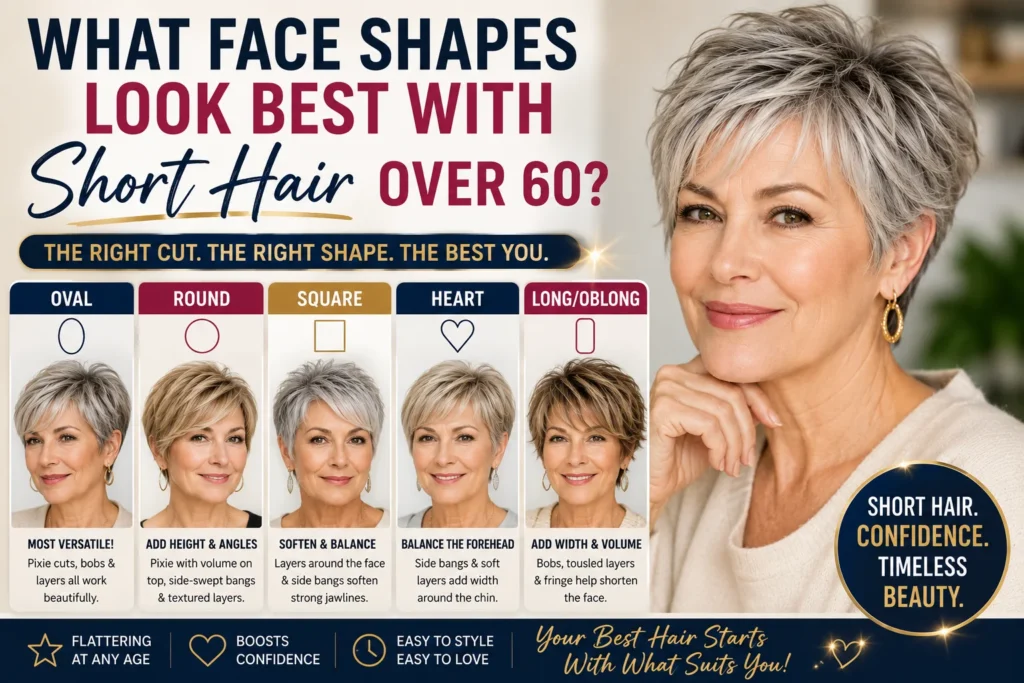
What Face Shapes Look Best With Short Hair Over 60?
Almost every face shape can work with some version of short hair — the key is knowing which structural elements to emphasize or soften.
Here’s what I recommend by face shape:
- Oval face: Lucky. Most short cuts work. Go for the pixie or crop without hesitation.
- Round face: Avoid cuts that add width at the cheeks. Opt for a tapered bob with volume at the crown, or a pixie with height on top.
- Square face: Soft layers and side-swept fringe balance a strong jawline beautifully.
- Heart-shaped face: Width at the chin level helps. A jaw-length bob or shag with volume below the ears works well.
- Long face: A fuller bob or voluminous short cut adds needed width. Avoid very flat, close-cropped styles.
One thing I always tell clients: your face shape doesn’t dictate your haircut. It informs it. You still get the final say. The goal is just to understand the geometry before you walk into the salon.
Is Short Hair Harder to Maintain After 60?
No. Short hair is almost always easier to maintain after 60 than longer hair — it requires fewer products, less drying time, and holds its shape longer between washes.
That said, “low maintenance” doesn’t mean “no maintenance.” Short cuts need more frequent trims — typically every 4 to 6 weeks — to hold their shape. If you’re stretching to 10 weeks between salon visits, a short cut will start looking grown-out and shapeless, which defeats the purpose.
What saves time is the day-to-day routine. Women with short hair over 60 often report dropping their morning routine from 30-40 minutes down to under 15. No detangling. No blow-drying long sections. No fighting with a curling iron on layers that won’t cooperate.
The products shift too. You’re working with:
- A light hold cream or paste for textured or wavy short cuts
- A volumizing mousse applied at the root for fine hair pixies
- A smoothing serum (a pea-sized amount) for sleek, polished bobs
- Dry shampoo between washes to maintain texture
Heavy products — thick serums, dense oils — tend to flatten short hair and make it look greasy by midday. Less is almost always more.
What Are the Most Flattering Short Hairstyles for Older Women With Thin Hair?
For women over 60 with thin or thinning hair, the most flattering short hairstyles create the illusion of density through layering, texture, and strategic length.
Thinning hair is one of the most common concerns I hear. And the good news is that short hair, done right, is genuinely one of the best solutions.
The textured pixie with soft layers is consistently my top recommendation here. Layers allow each section of hair to fall at a slightly different level, stacking visually and creating the appearance of more volume than is actually there. Add a gentle wave with a small-barrel iron, and suddenly fine hair looks deliberately tousled and full.
“A blunt bob can actually make thin hair look thinner because it shows exactly how much hair is there at the ends. Layers break that visual. They create movement, and movement reads as fullness.”
Other solid options for thin hair over 60:
- The feathered crop — face-framing layers, soft at the edges, lifts away from the scalp
- The choppy pixie — cut with point-cutting technique to add texture and depth
- The tousled lob — longer than a pixie but short enough to maintain volume
Avoid very blunt, one-length cuts if your hair is notably fine. They tend to hang flat and show exactly how sparse the ends are.
Color Choices That Make Short Hair Over 60 Look Younger (or More Intentional)
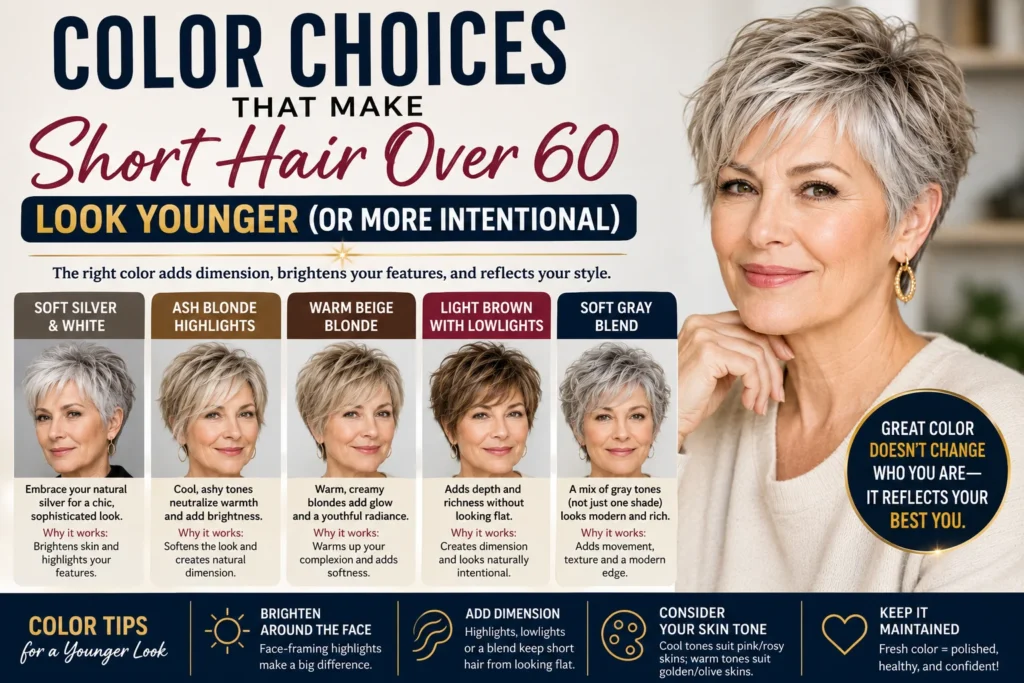
Color and cut work together. A great short cut with the wrong color can look dull. The right color on a great short cut? Completely different person walking out of the salon.
In 2026, the most flattering color directions for short hair on women over 60 include:
- Warm silver or platinum — embracing natural gray while keeping it bright and intentional rather than dull or washed-out
- Champagne blonde — works beautifully for fair skin tones, adds warmth without looking unnatural
- Ash brown with gray blending — for women partially gray who want a more gradual transition
- Bold single-process color — deep burgundy, warm copper, rich espresso — short hair carries color more vividly than long hair because there’s less of it to maintain
The money piece technique — framing the face with brighter highlights — has become a staple for short cuts over 60 because it draws attention upward and brightens the complexion. It’s not a dramatic change, but the visual effect is significant.
One thing I always flag: if you’re going shorter and lightening your hair at the same time, don’t do both in the same appointment. Lightening is a chemical process that affects hair structure. If you’re also going significantly shorter, cut first, assess the condition, then color. Doing them simultaneously increases the risk of over-processing — and on finer, older hair, that damage is harder to recover from.
How to Talk to Your Stylist About a Short Cut Over 60
Most women I’ve worked with who’ve had a bad haircut experience share the same story: they brought in a photo, the stylist said yes, and then what came back wasn’t what was in the photo. Not because anyone was careless — but because nobody had the conversation about why the photo worked for the model and whether it would work for the client.
Before your appointment, be ready to discuss:
- Your natural texture (straight, wavy, coarse, fine) — not what you do to it, what it is
- How much time you realistically want to spend styling — be honest
- Whether you want to grow it out eventually or commit to short-term maintenance
- Any areas of thinning or concern you want the cut to address
And bring two or three reference photos — not one. Multiple references let a stylist find the common thread in what you’re drawn to, which is usually more useful than one single photo you may have pinned from Pinterest in 2019.
What’s Trending Right Now in Short Hair for Women Over 60 in 2026
The soft textured crop is the breakout cut of 2026 for this demographic. It’s landing everywhere — not just on fashion-forward clients but on women who’ve worn the same bob for 15 years and finally tried something new. It’s short at the back, has soft texture through the top, and frames the face without requiring precision styling every single morning.
The grown-out pixie is also having a moment — that slightly-in-between stage where a pixie starts developing length at the top and sides is being treated as its own legitimate style rather than a phase to rush through. Stylists are carving this length intentionally and clients are leaning into it.
And the silver shag — medium-short, with lots of texture and movement, often in natural gray or platinum tones — is being worn with serious confidence in 2026. It’s arguably the most “anti-boring” short cut available right now, and it looks extraordinary on women who’ve stopped fighting their natural texture.
At the end of the day, the best short haircut for a woman over 60 is the one she actually feels good in. Not the one that’s most practical, or most age-appropriate by someone else’s definition, or the one her daughter thinks she should get. The cut that fits your face, your texture, your lifestyle, and — most importantly — your sense of who you are right now. That’s the cut worth getting.